Whether you're planning new sites, expanding current ones, optimising production, ensuring compliance or driving innovation, we deliver integrated, site‑specific solutions tailored to your operations. Based in Scotland - one of the world’s leading salmon aquaculture regions - we work with clients both locally and worldwide, applying our experience and expertise across diverse marine environments and regulatory frameworks.
As part of the global blue economy, finfish aquaculture plays a key role in sustainable food production and the responsible use of marine resources. As the sector grows, there is an increasing need for science-led insight to balance environmental protection with operational and production goals - a challenge we help our clients address.
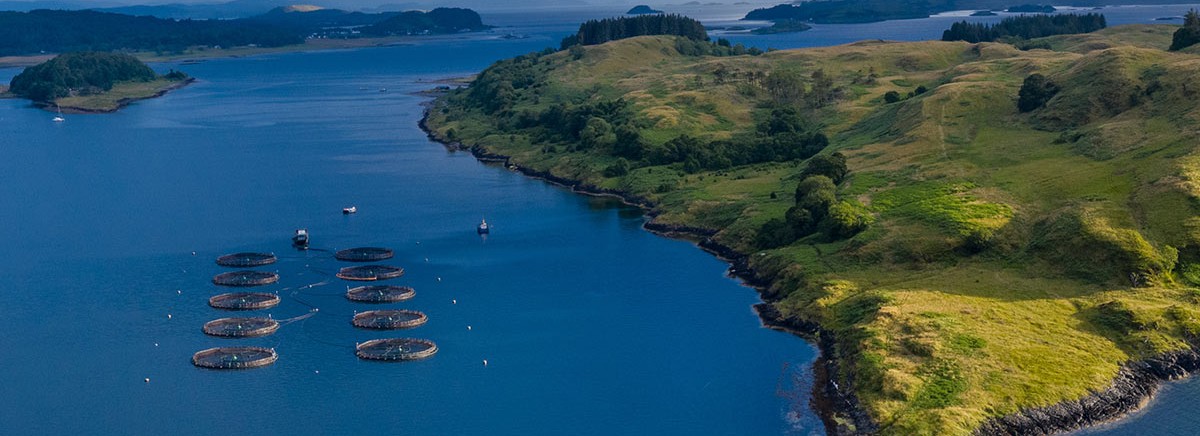
Our advanced particle-tracking modelling software is designed to predict the dispersion of fish farm waste in the benthic environment. It helps you plan and manage your sites licencing process, optimise production, and comply with regulatory and environmental requirements. NewDEPOMOD is available as licensed software or as a fully managed modelling service delivered by our team.
As a third-generation model, it has been developed and refined over decades and is widely used across the Scottish, Chilean, Norwegian, and Canadian salmon industries. Its users include fish farmers, regulators, consultants and researchers.
Using proven field sampling techniques, we assess sea lice larvae distribution in the water column.
The resulting evidence supports our modelling solutions, site and regional risk assessments and coordinated management planning across farming areas.
Our eDNA assessment provides near real-time insights into marine biodiversity and species presence, supporting informed, responsible decision-making.
Developed by our scientists, our eDNA2IQI software converts raw eDNA data into Infaunal Quality Index (IQI) scores, enabling quick, consistent environmental quality assessments without time-consuming sieving or the need for specialist taxonomists.
We use AI-driven image analysis, combining photogrammetry, computer vision and machine learning to monitor the seabed, identify Priority Marine Features, inspect infrastructure and classify benthic habitats.
This turns high-resolution imagery into consistent, scalable visual data, supporting the assessment of benthic impacts, habitat condition and site-specific environmental change.
We provide early-warning tools to predict the risk of harmful algal blooms and support mitigation strategies.
We use phytoplankton monitoring, environmental data and particle-tracking models to forecast bloom formation and movement across your sites. Our HAB reporting translates model outputs into clear information on bloom risk and movement, helping you plan operational responses.
We model current flow and dispersal pathways to inform site selection, farm planning and environmental risk assessment.
Our modelling draws on coastal modelling systems developed here at SAMS, including WeStCOMS (West Coast of Scotland Coastal Ocean Modelling System) and NORSCOMS (North Scotland Coastal Ocean Modelling System), to provide a regional context for assessments of sea lice dispersal and connectivity
We work with businesses and organisations across the aquaculture sector, from producers and regulators to technology providers and environmental stakeholders, providing scientific evidence to support planning, compliance, innovation and environmental management.
Regulatory bodies, councils and statutory consultees: We provide robust evidence to support environmental assessment, planning decisions and regulatory review.
Salmon and other finfish producers: We help you plan your sites, manage environmental risk, compliance and optimise farm performance.
Technology developers and supply chain partners: We provide scientific insight to support the innovation, development, validation and deployment of new technologies and solutions.