
SIMBA

Case Studies

High-Resolution Snow-Air Temperature Monitoring with SIMBA - the ICECAPS-ACE Project, Greenland

Introduction to the ICECAPS-ACE Project

The ICECAPS-ACE project (Integrated Characterisation of Energy, Clouds, Atmospheric state, and Precipitation at Summit - Aerosol Cloud Experiment) is an international scientific research programme based at Summit Station, Greenland. Jointly funded by the UK Natural Environment Research Council (NERC) and the US National Science Foundation (NSF), the project supports integrated observations of the Greenland environment, including energy exchange, cloud processes, atmospheric conditions, precipitation and aerosols.

As part of this work, two Snow Ice Mass Balance Apparatus (SIMBA) units were deployed to provide high-resolution temperature measurements across the snow-air transition zone. The measurements collected by the SIMBA units form part of the wider observational programme and are published by the Centre for Environmental Data Analysis (CEDA). First published in December 2023, the record is listed as ongoing and online, with the data collection continuing through a three-year ICECAPS-MELT extension of the project. As a public record of high-resolution snow-air transition temperature measurements, the dataset also demonstrates SIMBA’s role as a field instrument for cryospheric monitoring.


The Challenge

For the ICECAPS-ACE programme, researchers needed more than a single surface-temperature reading. They required detailed measurements showing how temperature changes across the snow–air transition zone at Summit Station - the boundary between the snowpack and the air above it.

Before the system was supplied, our SIMBA engineer worked with the project team through a deployment design consultancy process to identify the most suitable SIMBA configuration for the research requirement and operating environment. This included recommending a custom hybrid thermistor chain and mounting solution, selected from the SIMBA toolbox, to support reliable measurement across the snow-air transition.

To support the project, two SIMBA units were configured with bespoke 5 m (16.4 ft) long custom chain mounting solutions installed across the snow–air transition. With sensors spaced at 2 cm (0.8 in) intervals, the units provided the high-resolution vertical temperature profiles needed for the project, highlighting SIMBA’s suitability for detailed snow–air transition monitoring.

The deployment included two different generations of SIMBA, demonstrating the system’s evolution across field applications. The Generation 2 unit was powered by the station’s base power supply and connected to the project’s data recorder, while the early Generation 3 trial unit operated on battery power and transmitted data via Iridium satellite. Since this deployment, Generation 3 SIMBA has become the current platform for new systems, providing a flexible solution for both research and applied monitoring projects.

A key challenge at Summit Station was environmental resilience. Temperatures at the measurement site often fall below -40°C (-40°F), with extreme conditions reaching around -65°C (-85°F). During the deployment, SIMBA recorded temperatures as low as -67°C (-88.6°F) on the thermistor chain - the lowest temperature recorded by SIMBA to date. Although this is below the sensors' stated range, the system was able to detect the air-snow interface without requiring any engineering solutions.

Power performance was also a major success. While the Generation 2 unit is powered by the station’s base supply, the Generation 3 unit operates on a single battery supplied with the system and transmits data via the Iridium satellite network. The Generation 3 unit continued operating in the field for 20 months, with the battery consistently exposed to temperatures at or below -20°C (-4°F) throughout the deployment. The unit’s internal electronics include temperature indication, providing additional insight into battery conditions during operation. This provided valuable evidence of SIMBA’s capability for long-duration, low-power monitoring in remote polar environments.


What data does SIMBA provide?

Beyond the core temperature profile, the SIMBA measurement record includes supporting variables that help place each reading in context. This allows researchers to understand where, when and at what position along the chain each measurement was taken.

Key measurement outputs include:

  • Temperature readings: individual thermistor temperature values from the SIMBA chain, recorded across the snow–air transition zone.
  • Vertical position: sensor height relative to the highest sensor, helping identify where each reading was taken along the chain.
  • Location data: latitude and longitude for the measurement site.
  • Time information: date and time variables that support detailed time-stamping of the measurements.
  • Quality information: temperature quality-control flags included within the dataset.
  • System information: battery voltage, providing additional instrument-related context for interpreting data from remote deployment.

Together, these outputs mean the SIMBA record captures both environmental data and instrument-related information, giving additional context when working with data from remote polar monitoring sites.

The value of the SIMBA measurements lies in their ability to convert the snow-air boundary into a measurable vertical temperature record. For the ICECAPS-ACE programme, this adds detailed snow and temperature information to a wider set of observations focused on energy, clouds, atmospheric state and precipitation at Summit Station. The SIMBA record helps place near-surface temperature structure within that broader environmental context, supporting research into how snow-surface conditions relate to atmospheric processes.

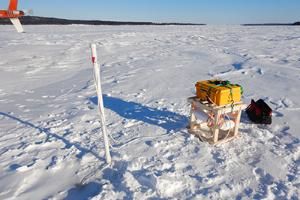
SIMBA monitoring equipment installed on the snow-covered Greenland Ice Sheet beneath a clear blue sky. A vertical white thermistor chain is secured beside a guyed support mast and connected by cables to a yellow protective equipment case on the snow. A red marker flag identifies the installation.

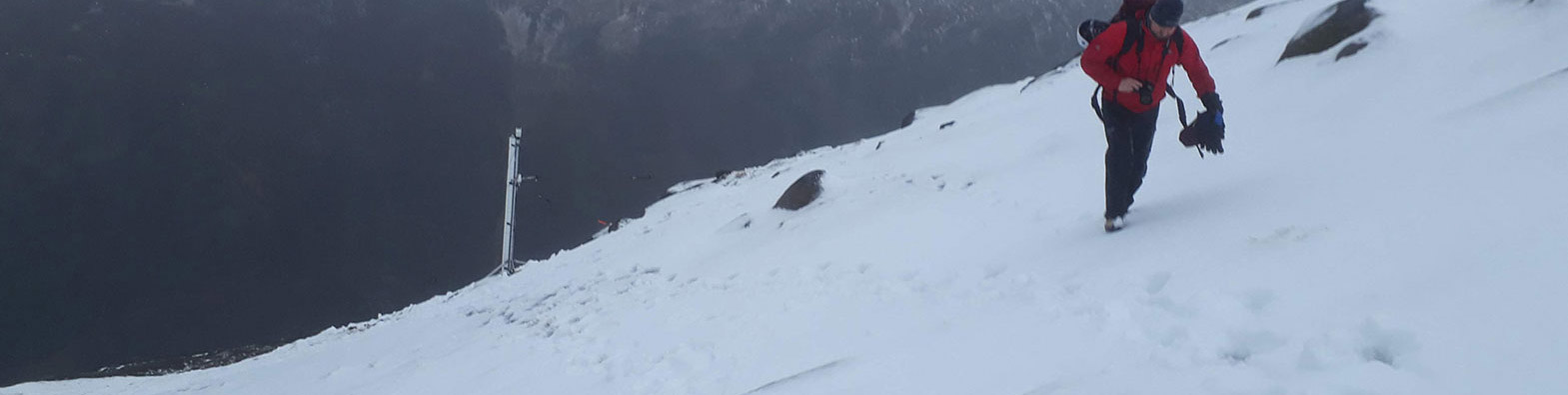
Close-up of a white SIMBA thermistor chain laid horizontally across a silver support pole on snow. Red spacing bands secure the chain at regular intervals, with footprints, equipment tracks and disturbed snow visible around the installation area.

Client: National Centre for Atmospheric Science

Project Type: Snow and Ice Monitoring

Status: Ongoing

Location: Summit Station, Greenland

Services Provided:

  • SIMBA deployment design consultancy
  • SIMBA custom chain mounting solution design and supply
  • SIMBA instrumentation supply
  • On-site deployment support
  • Remote polar monitoring configuration
  • Cryospheric research instrumentation support

300 wide

Monitoring River Ice on the Churchill River, Canada

The Churchill River Monitoring project was established after a flood in 2017 where an ice jam flood occurred at the outlet into Goose Bay, causing the evacuation of a nearby community. As such, it was recommended to increase the real-time environmental monitoring and, to help achieve this, SIMBA units were deployed to help study the river ice thickness and contribute to the wider River Flood Forecasting System.

Four SIMBA units were deployed at set points along the river and fitted with flotation devices to aid retrieval at the end of each season.

The units autonomously return data every 6 hours, minimising the risk to personnel by reducing the number of visits onto the ice. The SIMBA units work alongside helicopter-mounted ground-penetrating radar and manual measurements to determine the river ice thickness throughout the season.

The SIMBA units have been retrieved and reused for multiple winter seasons, with thermistor chains and batteries being replenished as required.

To combat the faster-flowing river water, a wider thermistor chain was developed, providing additional strength and support. Since its creation, this wider chain has also been successfully used to study lake ice and snowpack properties.

To find out more about this project:

With thanks to C-CORE and the Government of Newfoundland and Labrador IceSight App.

SIMBA On Sea Ice - The MOSAiC Expedition, Central Arctic

The MOSAiC Expedition, led by the Alfred Wegener Institute, was a year-round operation of the RV Polarstern, which drifted with the sea ice across the central Arctic from September 2019 to October 2020. A distributed regional network of observational sites was set up, and as part of this, 28 SIMBA units were deployed on the sea ice.

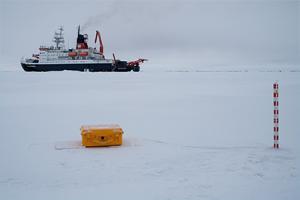
A typical deployment consists of a yellow case, housing the controller unit, communications, and batteries. A 5m thermistor chain is then deployed through an auger hole in the ice and frozen into place to collect snow, ice, water, and air temperature data.

The SIMBA units are compact and portable, which allowed them to be installed by a small deployment team. The setup is very quick and simple, with an estimated 20-30 minutes required to fully deploy each unit on the ice. Once deployed, the units were left to collect data and return this via Iridium to an online data portal.

The SIMBA units were used to study sea ice mass balance data, sea-ice drift data, and temperature profiles of the snow, air, ice, and water. This also allowed the interfaces between these materials to be studied by the scientists.

Data was collected multiple times a day with each unit being deployed for weeks and months at a time.

Find out more about the expedition:

With thanks to the Alfred Wegener Institute and collaborating parties on the MOSAiC Expedition.
300 wide