Applied marine science for the seaweed industry

Investigating kelp development on 3D-printed artificial reefs


Last Updated: November 2026


ReefCircular worked with the SAMS Enterprise Seaweed Nursery team to explore the potential of a new 3D-printed artificial reef product designed to support marine habitat creation.

Our Nursery team designed and delivered a controlled 12-week nursery study, monitoring the settlement, growth and attachment of sugar kelp spores on prototype structures. The project generated valuable evidence to guide the product’s continued development and inform future testing under natural marine conditions.


Project overview

Kelp forests provide important habitats for marine life, but restoring them depends in part on giving young kelp a suitable surface on which to grow. ReefCircular is developing artificial reef structures designed to provide a temporary surface on which marine life can establish. Working with SAMS Enterprise and our specialist Seaweed Nursery team, the company set out to determine whether its prototypes could support early sugar kelp (Saccharina latissima) growth.

The prototypes were used in a modified Green Gravel approach, with kelp grown on them under controlled nursery conditions. The study examined whether kelp spores would settle and develop into sporophytes that could establish and attach to the structures. It also monitored the prototypes for changes during the nursery phase.
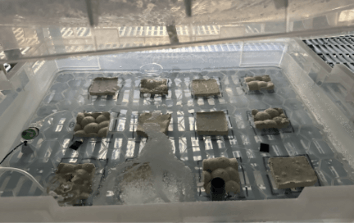
ReefCircular prototype structures in seawater tanks at the start of a 12-week study in the SAMS Enterprise Seaweed Nursery.

ReefCircular prototype structures deployed into seawater tanks at the beginning of the 12-week study in the SAMS Enterprise Seaweed Nursery.

Image: Joanna Forsyth, Seaweed Nursery Technician
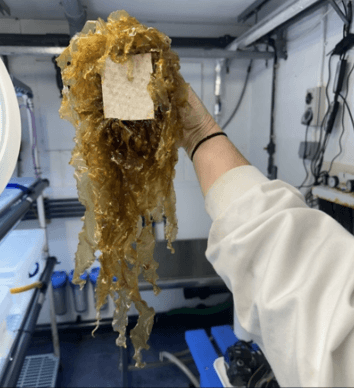
A ReefCircular prototype structure covered in long brown seaweed growth being lifted from a seawater tank in the SAMS Enterprise Seaweed Nursery.

Sugar kelp sporophytes established on a ReefCircular prototype structure at the end of the 12-week study in the SAMS Enterprise Seaweed Nursery.

Image: Joanna Forsyth, Seaweed Nursery Technician

Project at-a-glance

Client: ReefCircular, Denmark

Sector: Marine restoration / Blue economy

Project: Controlled seaweed nursery study

Services provided:

  • Trial design and project management
  • Collection and preparation of fertile sugar kelp material
  • Controlled seeding of prototype reef structures
  • Maintenance and monitoring of the nursery trial
  • Assessment of kelp settlement, growth and attachment
  • Environmental and prototype monitoring
  • Analysis, interpretation and reporting

Species: Sugar kelp (Saccharina latissima)

Project duration: 12 weeks, March to May 2026

Project stage: Nursery study completed; field monitoring ongoing

This project was supported by Marine Fund Scotland and The Fishmongers’ Company, with The Kelp Conservation Initiative contributing as a project partner.
 

A controlled Seaweed Nursery study

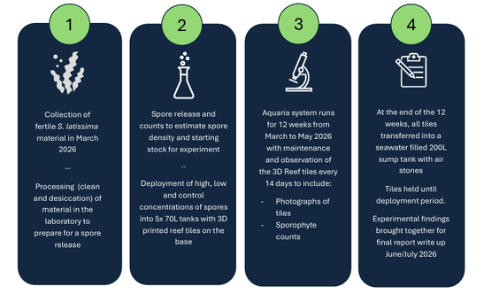
The SAMS Enterprise project team designed and delivered a 12-week study in our specialist Seaweed Nursery. Fertile sugar kelp was collected locally and prepared for spore release before being introduced to aquarium systems containing ReefCircular’s prototype structures. Low- and high-density spore treatments were included to examine how the initial seeding level influenced settlement and subsequent development, alongside an unseeded control.


Four-stage timeline of the 12-week sugar kelp nursery study, covering preparation of fertile material, spore release and seeding, aquarium monitoring, and completion of the experimental phase.

The 12-week nursery study followed the project from the collection and preparation of fertile sugar kelp through spore release, controlled cultivation and monitoring, to completion of the experimental phase. Image: SAMS Enterprise Seaweed Nursery


The team maintained the aquarium systems and monitored temperature, salinity, pH and light throughout the trial. Microscopy and photography were initially used to confirm settlement and follow the early stages of development. As the sporophytes grew, the assessment method was adapted to allow structured counts to continue despite increasingly dense and overlapping kelp growth.

Attachment was examined during the later monitoring stages, when sporophytes were removed for counting. The structures were also monitored for visible signs of change, while control structures were weighed before and after the trial to provide an initial assessment of stability during the nursery phase.

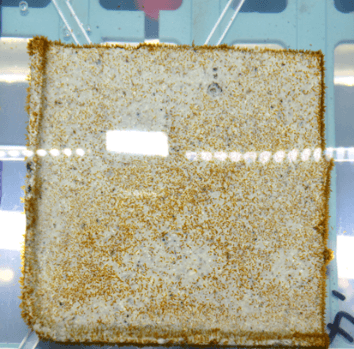
Overhead view of a rectangular ReefCircular prototype structure, with small brown sugar kelp sporophytes growing densely across its pale surface after five weeks in controlled nursery conditions.

ReefCircular’s prototype structures were exposed to sugar kelp spores under controlled nursery conditions. Small sporophytes began to appear on the structures’ surfaces during week 5 of the study.

Image: Joanna Forsyth, Seaweed Nursery Technician

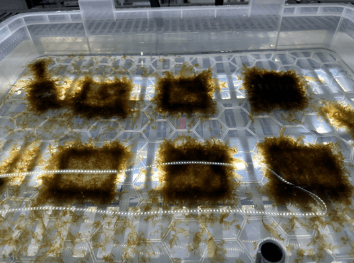
Brown sugar kelp sporophytes growing densely across several rectangular prototype structures in a seawater tank.

Sugar kelp sporophytes began to cover the surfaces of the structures during week 8 of the study. The sporophytes competed for available surface space on which to settle and establish.

Image: Joanna Forsyth, Seaweed Nursery Technician


"At ReefCircular, our goal is to restore damaged marine habitats and increase marine biodiversity using artificial reefs. It’s been a true pleasure working with SAMS to test how our biodegradable shell-based artificial reefs can be used in kelp restoration. We’ve seen the kelp really liked the tiles in the lab; now we’re excited to see how the kelp and tiles respond after a year in the sea.
SAMS’s expertise, facilities, and willingness to try something a bit different have led to a great collaboration, and I’m sure we’ll work together on other projects in the future!”

Shannon Hanson, PhD
Founder of ReefCircular, Marine Scientist

The results: Kelp settlement, growth and attachment

Sugar kelp developed across all seeded treatment groups, demonstrating that the prototype structures could support spore settlement and early sporophyte growth under controlled nursery conditions.

The study also produced encouraging evidence of attachment. As the kelp developed, its holdfasts became well integrated with the prototype surfaces, indicating that the structures could support secure attachment during the nursery phase.

Higher spore densities initially produced greater numbers of sporophytes. Their density subsequently reduced as the kelp grew and required more surface area, providing useful evidence for planning future seeding and cultivation work.

No measurable loss in dry weight or visible deterioration was detected in the control structures during the 12-week trial.

Together, the findings provided ReefCircular with proof-of-concept evidence that its prototypes could support the early establishment of sugar kelp under controlled nursery conditions. Longer-term monitoring will assess kelp retention and prototype performance in the natural marine environment.

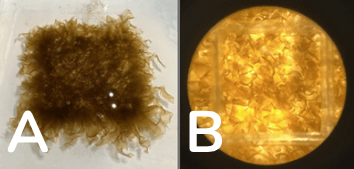
Sugar kelp development on a prototype structure, showing dense coverage across the surface (A) and the developing sporophytes under magnification within a 1cm grid square (B).

Sugar kelp development on a prototype structure, showing dense coverage across the surface (A) and developing sporophytes under magnification within a 1 cm grid square (B).

Image: Joanna Forsyth, Seaweed Nursery Technician


"The SAMS Nursery team really enjoyed engaging and delivering this project. It allowed us to apply our existing skills to a new method of seeding seaweed and led to positive observations around the ReefCircular materials. This project also allowed the team to learn more about the settlement behaviour of kelp spores and how our systems can support this type of research. We are excited to see what happens to these tiles in the marine environment and will be able to report on that within the next year. We are really hopeful that we can take the opportunity to work with ReefCircular again and continue towards identifying sustainable restoration materials."

Rob Grisenthwaite
Seaweed Nursery Manager, SAMS Enterprise

Progressing to field monitoring

Following the nursery study, the kelp-covered structures were transferred to the marine environment for the next phase of the project. Longer-term monitoring will assess performance under natural conditions and determine whether the nursery study's encouraging findings hold in the field.

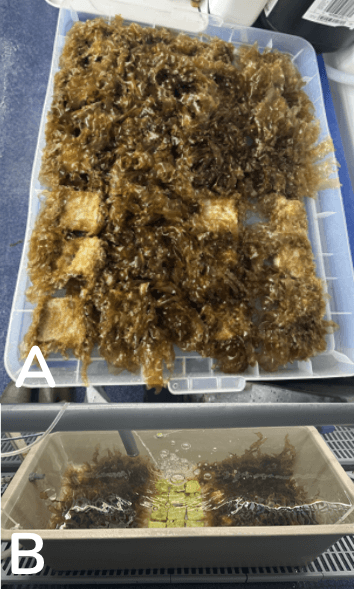
Prototypes subjected to spore-release-seeded treatments show dense sugar kelp growth.

Prototypes subjected to spore-release-seeded treatments show dense sugar kelp growth at the end of the 12-week study in the SAMS Enterprise Seaweed Nursery (A). Prototypes held in a holding tank prior to deployment, with treatment prototypes positioned to the left and right of sporophyte-free control prototypes in the centre (B).

Image: Joanna Forsyth, Seaweed Nursery Technician

.