Addressing a complex monitoring challenge for stronger baseline evidence
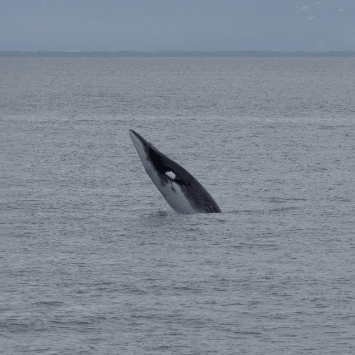
Assessing the potential effects of planned offshore wind developments required a clearer understanding of when minke whales were present in the area. However, limited long-term data made it difficult to identify seasonal patterns or understand how their occurrence varied between years and monitoring locations.
The project addressed this gap by analysing ten years of passive acoustic monitoring data to establish a more robust baseline of minke whale occurrence.
The team analysed passive acoustic monitoring data collected between 2015 and 2025. The dataset combined recordings from six moorings in the ongoing Scottish Passive Acoustic Network, supported by the Scottish Government, with data from three additional monitoring units in the Southern Trench MPA. These additional units formed part of a two-year targeted monitoring campaign funded by offshore wind developers.
Analysing ten years of broadband recordings across multiple locations required an efficient way to identify minke whale vocalisations. A recently developed machine-learning tool automatically detected minke whale songs, with detections manually reviewed where necessary to validate the results. This enabled the team to examine seasonal, interannual and spatial patterns in minke whale occurrence across the study area.
In total, the analysis identified 651 minke whale detections across 3,902 monitored days at nine locations.
Cross-organisational project
Project Type: Marine renewable energy - offshore wind and marine environmental monitoring
Status: Ongoing
Location: Moray Firth, including the Southern Trench MPA, North Sea, Scotland, UK
Services Provided:
- Long-term passive acoustic dataset analysis
- Marine mammal occurrence and seasonality assessment
- Automated analysis of minke whale vocalisations using a machine-learning detection tool
- Manual validation of automated detections
- Interpretation of spatial, seasonal and interannual patterns
- Scientific evidence to support offshore wind impact assessment
- Evidence to inform future monitoring and management of the Southern Trench MPA