
Last Updated: September 2026
As part of this work, two Snow Ice Mass Balance Apparatus (SIMBA) units were deployed to provide high-resolution temperature measurements across the snow-air transition zone. The measurements collected by the SIMBA units form part of the wider observational programme and are published by the Centre for Environmental Data Analysis (CEDA). First published in December 2023, the record is listed as ongoing and online, with the data collection continuing through a three-year ICECAPS-MELT extension of the project. As a public record of high-resolution snow-air transition temperature measurements, the dataset also demonstrates SIMBA’s role as a field instrument for cryospheric monitoring.
For the ICECAPS-ACE programme, researchers needed more than a single surface-temperature reading. They required detailed measurements showing how temperature changes across the snow–air transition zone at Summit Station - the boundary between the snowpack and the air above it.
Before the system was supplied, our SIMBA engineer worked with the project team through a deployment design consultancy process to identify the most suitable SIMBA configuration for the research requirement and operating environment. This included recommending a custom hybrid thermistor chain and mounting solution, selected from the SIMBA toolbox, to support reliable measurement across the snow-air transition.
To support the project, two SIMBA units were configured with bespoke 5 m (16.4 ft) long custom chain mounting solutions installed across the snow–air transition. With sensors spaced at 2 cm (0.8 in) intervals, the units provided the high-resolution vertical temperature profiles needed for the project, highlighting SIMBA’s suitability for detailed snow–air transition monitoring.
The deployment included two different generations of SIMBA, demonstrating the system’s evolution across field applications. The Generation 2 unit was powered by the station’s base power supply and connected to the project’s data recorder, while the early Generation 3 trial unit operated on battery power and transmitted data via Iridium satellite. Since this deployment, Generation 3 SIMBA has become the current platform for new systems, providing a flexible solution for both research and applied monitoring projects.
A key challenge at Summit Station was environmental resilience. Temperatures at the measurement site often fall below -40°C (-40°F), with extreme conditions reaching around -65°C (-85°F). During the deployment, SIMBA recorded temperatures as low as -67°C (-88.6°F) on the thermistor chain - the lowest temperature recorded by SIMBA to date. Although this is below the sensors' stated range, the system was able to detect the air-snow interface without requiring any engineering solutions.
Power performance was also a major success. While the Generation 2 unit is powered by the station’s base supply, the Generation 3 unit operates on a single battery supplied with the system and transmits data via the Iridium satellite network. The Generation 3 unit continued operating in the field for 20 months, with the battery consistently exposed to temperatures at or below -20°C (-4°F) throughout the deployment. The unit’s internal electronics include temperature indication, providing additional insight into battery conditions during operation. This provided valuable evidence of SIMBA’s capability for long-duration, low-power monitoring in remote polar environments.
Client: National Centre for Atmospheric Science
Project Type: Snow and Ice Monitoring
Status: Ongoing
Location: Summit Station, Greenland
Services Provided:
"Working with the team from SAMS has felt more like a scientific collaboration than a one-off equipment purchase. Their continued willingness to provide support, advice, and ongoing discussion after our initial instrument deployment has been extremely beneficial to both our science research objectives and the ongoing development of the SIMBA unit."
Dr Heather Guy, Research Fellow in Polar Observational Meteorology, National Centre for Atmospheric Science, UK
Beyond the core temperature profile, the SIMBA measurement record includes supporting variables that help place each reading in context. This allows researchers to understand where, when and at what position along the chain each measurement was taken.
Key measurement outputs include:
Together, these outputs mean the SIMBA record captures both environmental data and instrument-related information, giving additional context when working with data from remote polar monitoring sites.
The value of the SIMBA measurements lies in their ability to convert the snow-air boundary into a measurable vertical temperature record. For the ICECAPS-ACE programme, this adds detailed snow and temperature information to a wider set of observations focused on energy, clouds, atmospheric state and precipitation at Summit Station. The SIMBA record helps place near-surface temperature structure within that broader environmental context, supporting research into how snow-surface conditions relate to atmospheric processes.
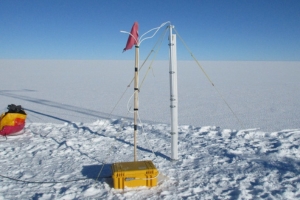
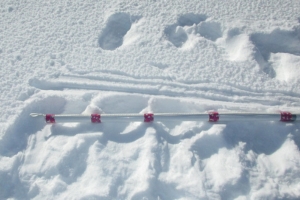
Photo credit: ICECAPS-ACE