
The ICECAPS-ACE project (Integrated Characterisation of Energy, Clouds, Atmospheric state, and Precipitation at Summit - Aerosol Cloud Experiment) is an international scientific research programme based at Summit Station, Greenland. Jointly funded by the UK Natural Environment Research Council (NERC) and the US National Science Foundation (NSF), the project supports integrated observations of the Greenland environment, including energy exchange, cloud processes, atmospheric conditions, precipitation and aerosols.
As part of this work, two Snow Ice Mass Balance Apparatus (SIMBA) units were deployed to provide high-resolution temperature measurements across the snow-air transition zone.
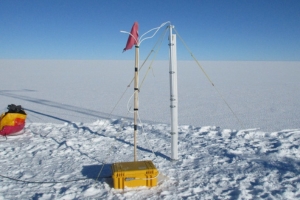
Photo credit: ICECAPS-ACE
Storm-force winds made higher-altitude observations difficult in the Northern Cairngorms. SIMBA provided remotely accessible temperature profiles and heat maps, allowing forecasters to examine how the snowpack was changing between field observations
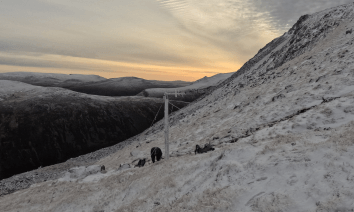
Photo credit: SAIS Northern Cairngorms
The Churchill River Monitoring project was established after a flood in 2017 where an ice jam flood occurred at the outlet into Goose Bay, causing the evacuation of a nearby community. As such, it was recommended to increase the real-time environmental monitoring and, to help achieve this, SIMBA units were deployed to help study the river ice thickness and contribute to the wider River Flood Forecasting System.
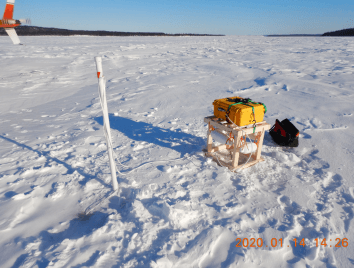
Photo credit: Churchill River Monitoring Project
The MOSAiC Expedition, led by the Alfred Wegener Institute, was a year-round operation of the RV Polarstern, which drifted with the sea ice across the central Arctic from September 2019 to October 2020. A distributed regional network of observational sites was set up, and as part of this, 28 SIMBA units were deployed on the sea ice.
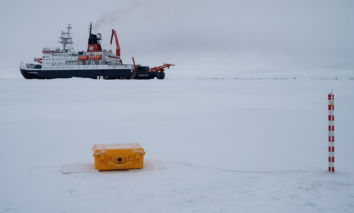
Photo credit: MOSAiC Expedition