
A distributed regional network of observational sites was set up, and as part of this, 28 SIMBA units were deployed on the sea ice.
A typical deployment consists of a yellow case, housing the controller unit, communications, and batteries. A 5m thermistor chain is then deployed through an auger hole in the ice and frozen into place to collect snow, ice, water, and air temperature data.
The SIMBA units are compact and portable, which allowed them to be installed by a small deployment team. The setup is very quick and simple, with an estimated 20-30 minutes required to fully deploy each unit on the ice. Once deployed, the units were left to collect data and return this via Iridium to an online data portal.
The SIMBA units were used to study sea ice mass balance data, sea-ice drift data, and temperature profiles of the snow, air, ice, and water. This also allowed the interfaces between these materials to be studied by the scientists.
Data were collected multiple times a day, with each unit being deployed for weeks and months at a time.
Find out more about the expedition:
With thanks to the Alfred Wegener Institute and collaborating parties on the MOSAiC Expedition.
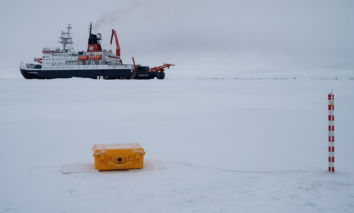
Photo credit: MOSAiC Expedition