
SIMBA’s development was shaped not by a single project, but by years of deployments across different snow and ice environments. From early polar trials and large international research programmes to river-ice monitoring, mountain snowpacks and glacier research, each application tested the system in new conditions and contributed to the versatile Snow and Ice Mass Balance Apparatus available today.
Late 2000s
Between 1979 and 2008, the summer extent of Arctic sea ice fell dramatically, while submarine observations suggested that the ice had also become substantially thinner. Scientists could observe the broad geographical extent of sea ice from satellites, but models still lacked sufficient long-term measurements to capture the complete annual cycle of ice growth and decay.
To understand how the polar environment was changing, researchers needed to measure more than the area covered by ice. They also needed continuous observations of snow accumulation, ice formation, surface melting and melting beneath the ice.
Achieving this across the Arctic and Antarctic would require a network of autonomous instruments capable of operating reliably for extended periods in remote, extreme environments. However, the cost and complexity of the available systems made monitoring on that scale difficult.
Researchers at the Scottish Association for Marine Science (SAMS) set out to develop a simpler, more affordable solution. With support from the Natural Environment Research Council, the team began work on what was originally described as a “novel, low-cost sea-ice mass balance buoy.”
"The objective was ambitious but practical: to create an instrument that could be deployed quickly, left unattended and trusted to collect high-quality observations throughout the changing seasons"
Early 2010s
At the heart of the new instrument was a thermistor chain: a flexible strip carrying a series of temperature sensors. Installed vertically through an auger hole in the ice, the chain extended from the air above, through the snow and ice, and into the seawater below.
Thermistor chains had already been used in polar research, but developments in digital sensor technology allowed the SAMS team to connect multiple sensors using only three shared wires, simplifying the cabling, and reducing the size and cost of the system. This simplified the cables and connectors, reducing the cost, size and complexity of the system, while also supporting reliability in the field.
By recording temperatures at regular intervals along the chain, the instrument could build a detailed profile of the environment. Researchers could then use that profile to investigate snow depth, ice thickness and changes occurring within the snow and ice.
However, temperature alone could not always provide the full answer.
During summer, the air, snow, ice and water can hold similar temperatures. When this happens, the boundaries between the different materials become difficult to identify from an ordinary temperature profile. Without knowing precisely where the air, snow, ice and water interfaces were located, researchers could not reliably calculate ice thickness or mass balance. The SAMS team addressed this by adding a small heating element beside each temperature sensor. This active-heating technique became one of SIMBA’s defining innovations. It enabled the system to identify environmental interfaces even when the underlying temperature profile showed very little variation. The same principle remains fundamental to SIMBA today.
The instrument combined its thermistor chain with a surface controller containing the batteries, controller board, and modem. Iridium satellite communication allowed SIMBA to transmit temperature and location data from remote polar environments, establishing a capability that remains integral to the system today.
The design was deliberately compact and straightforward to install. The narrow thermistor chain is lowered through a standard auger hole used for ice-thickness measurements, allowing deployment to be completed without heavy or highly specialised field equipment.
Early systems were installed in sea-ice zones in both the Arctic and Antarctic. Approximately 20 deployments took place, with the longest successful deployment lasting around 15 months.
The system was initially known as the Sea Ice Mass Balance Array, reflecting its original purpose. As the technology developed and its applications extended beyond sea ice, SIMBA became the Snow and Ice Mass Balance Apparatus. The current name recognises the instrument’s ability to monitor terrestrial snowpacks, river and lake ice, glaciers and other frozen environments as well as polar sea ice.
An important milestone came in 2013 with the publication of A Novel and Low-Cost Sea Ice Mass Balance Buoy in the Journal of Atmospheric and Oceanic Technology. The paper documented the instrument’s development and established its underlying scientific and technical principles.
The publication helped position SIMBA as a scientifically rigorous tool that could make autonomous sea-ice observations more accessible. Rather than relying on a small number of expensive monitoring stations, research programmes could deploy multiple portable systems to create broader networks of observation points.
As deployments accumulated, the technology continued to develop through field experience. The controller board became more robust and power-efficient, while satellite communications enabled data to be returned from locations that researchers could not regularly revisit. Remote configuration also allowed certain operating settings to be changed after deployment.
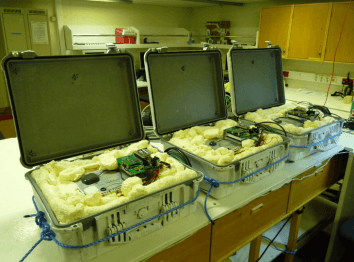
Photo credit: SAMS
2017 onwards
As SIMBA’s capabilities became more widely understood, the technology began to move beyond its original role in polar research.
An important example came from the Churchill River in Labrador, Canada. In 2017, an ice-jam flood occurred near the river’s outlet into Goose Bay, leading to the evacuation of a nearby community. Following the event, improved real-time environmental monitoring was recommended to support river-ice assessment and flood forecasting.
Four SIMBA units were deployed at fixed points along the river to help monitor ice thickness and contribute to the wider River Flood Forecasting System. The units autonomously returned data every six hours, reducing the number of visits personnel needed to make onto the ice. SIMBA observations were used alongside helicopter-mounted ground-penetrating radar and manual measurements.
The units were recovered and reused over multiple winter seasons, with batteries and thermistor chains replenished as necessary. The conditions on a flowing river also presented new engineering requirements. A wider and therefore stronger thermistor chain was developed to provide greater support in faster-moving water.
This adaptation subsequently found applications in lake ice and terrestrial snowpacks. It is a clear example of how SIMBA evolved in response to practical field requirements, with a solution developed for one environment opening opportunities in several others.
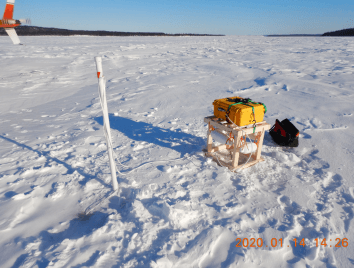
Photo credit: Churchill River Monitoring Project
Late 2019-2020
One of the most significant chapters in SIMBA’s history came during the Multidisciplinary drifting Observatory for the Study of Arctic Climate, better known as the MOSAiC expedition.
Led by the Alfred Wegener Institute, MOSAiC was a year-long international research programme during which the research icebreaker RV Polarstern drifted with Arctic sea ice from September 2019 to October 2020. A distributed network of observation sites was established around the vessel to study interactions between the atmosphere, ocean, snow and sea ice.
Twenty-eight SIMBA units were deployed as part of this network. Each installation typically consisted of a surface-situated Peli case housing the controller, batteries and communications equipment, connected to a thermistor chain installed vertically through the ice.
The units collected temperature profiles of air, snow, ice, and water, helping researchers investigate sea-ice mass balance, ice drift, and the changing interfaces between the different materials. Measurements were taken several times a day, and data were transmitted via Iridium to an online portal. Depending on individual requirements and conditions, the instruments operated for periods ranging from weeks to months.
The use of 28 units demonstrated SIMBA’s suitability for the distributed monitoring network envisaged at the outset of its development. A scientific concept created to fill a gap in polar observations has become part of one of the largest and most ambitious Arctic research expeditions ever undertaken.
Find out more about the expedition:
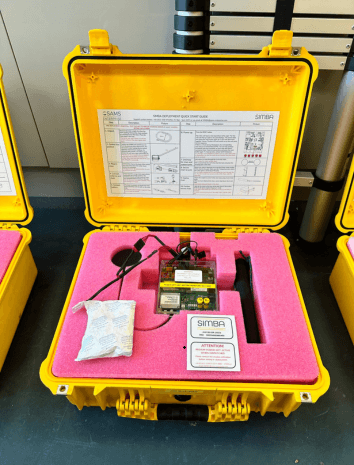
Photo credit: SAMS
Early 2020s
SIMBA’s active-heating capability also made the system valuable for studying mountain snowpacks.
In partnership with the Scottish Avalanche Information Service and Cairngorm Mountain, SAMS Enterprise used SIMBA to investigate whether autonomous temperature measurements could support avalanche forecasting. During a trial in Strath Nethy on the north-east side of Cairngorm, temperature readings were collected every two hours at two-centimetre intervals and returned through a mobile network.
In February 2020, the system recorded the development of a snowpack that later contributed to an avalanche. A conventional temperature-gradient profile showed wet snow near the ground and a relatively uniform gradient through the overlying dry snow. However, SIMBA’s heating and cooling measurements revealed an additional low-density layer that was not apparent in the standard profile.
About seven hours later, a walker triggered an avalanche around 100 metres from the instrument. The avalanche propagated across the slope, and the debris reached the SIMBA installation.
The event demonstrated the additional information that active thermal measurements can provide. It also illustrated SIMBA’s growing relevance to operational applications where remote monitoring can support specialists responsible for assessing environmental hazards.
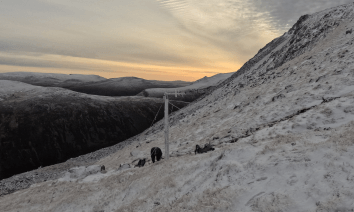
Photo credit: SAIS Cairngorms
Late 2022 onwards
SIMBA has continued to be deployed in some of the world’s most demanding conditions. Its widening applications include sea ice, river ice, lake ice, mountain snowpacks and glacier environments.
In 2022, two SIMBA units with bespoke five-metre thermistor chains and custom mounting solutions were deployed at Summit Station, Greenland, approximately 3,000 metres above sea level. The systems provided high-resolution temperature measurements across the snow-air transition zone as part of the ICECAPS-ACE observational programme.
SIMBA recorded thermistor-chain temperatures as low as −67 °C (-88.6 °F), the lowest recorded by the system to date, while continuing to detect the air-snow interface. An early Generation 3 unit also operated for 20 months on a single battery, transmitting data via Iridium despite prolonged exposure to extreme cold.
The deployment demonstrated SIMBA’s ability to support long-term, low-power snow monitoring in a remote polar environment and provided valuable field evidence that helped shape the current Generation 3 system.
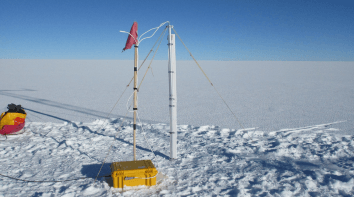
Photo credit: ICECAPS-ACE
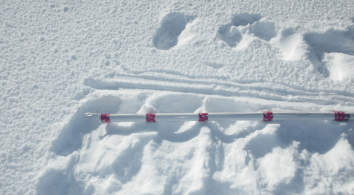
Photo credit: ICECAPS-ACE
2025 onwards
SIMBA’s impact is now evident in its contributions to international environmental research. Data from the instruments contributed to more than 70 peer-reviewed scientific papers (PDF) by October 2025, covering subjects ranging from sea-ice mass balance and snow properties to atmosphere-ice-ocean interactions. A consolidated dataset published in 2025 brought together observations from 96 SIMBA buoys deployed across the Arctic and Southern oceans between 2012 and 2023. The collection provides temperature records and derived information on sea-ice thickness, snow depth and the interfaces between the atmosphere, snow, ice and ocean.
What began as an effort to develop a novel and affordable sea-ice mass balance buoy has grown into a versatile, scientifically proven monitoring system. SIMBA’s story is one of continuous, science-led innovation, from identifying an urgent measurement gap to building a practical instrument, proving it in the world’s harshest environments and adapting it to meet new scientific and operational challenges.
Today, SIMBA is no longer solely a sea-ice research buoy. It is an autonomous snow-and-ice monitoring platform supporting climate science, environmental safety and infrastructure management.
Its users include polar and alpine researchers, sea-ice scientists, limnologists, avalanche forecasters, river-ice monitoring programmes, hydroelectric operators, engineers and organisations responsible for transport and infrastructure in cold environments. SIMBA units have been used across the Arctic and Antarctic, northern Europe and Canada, providing observations from locations where regular manual measurements would be difficult, costly or hazardous.
Despite this expansion, the purpose at the heart of SIMBA remains closely connected to its beginnings: making reliable snow-and-ice observations available from remote and extreme environments.
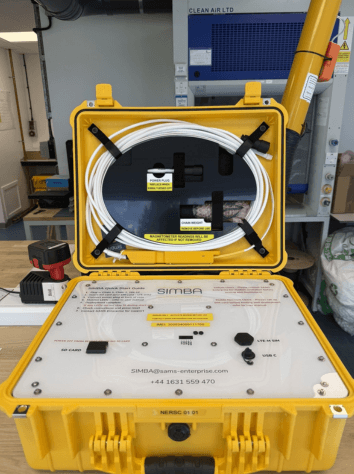
Photo credit: SAMS